
Keeping the past alive
Teri Saylor
Special to Publishers' Auxiliary
Aug 1, 2026
Newspaper archives hold the key to an important oral history project in North Carolina
In Coastal North Carolina, a researcher’s deep dive into the Carteret County News-Times archives led him to uncover a treasure trove of local history that no one in the county knew existed.
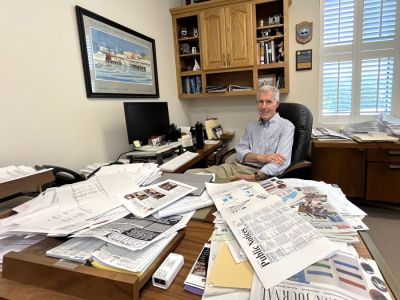
Publisher Lockwood Phillips isn’t surprised at the find and says this is what newspaper archives are for.
“Archives are absolutely critical because they provide a line of continuity dating from the creation of our community to its current status,” he said in a recent interview from his office in Morehead City.
The small, 10-inch clipping from a 49-year-old issue of the News-Times unlocked a series of important oral history recordings that recently made their way back to the county and into the hands of a local museum. They filled a vital gap in an extensive history project that chronicles life in Down East North Carolina, dating back more than 60 years.
Born and raised in Morehead City, Shannon Adams grew up an avid News-Times reader.
In his mind’s eye, the image of the local newspaper sitting on his family’s kitchen table has stuck with him for years. Even after he left home in 1990 for college at Appalachian State University in Boone, he subscribed to the News-Times, and he’s still a subscriber.
“Across my whole life I’ve always been into local news,” he said.
DIGITIZING THE PAST
On a hot summer day, Adams sits in the house his great-grandparents purchased in 1918. He’s with Karen Willis Amspacher, the executive director of the Core Sound Waterfowl and Heritage Center, a museum on Harkers Island.
Located about 30 miles east of Morehead City, Harkers Island is one of 13 unincorporated communities Down East — a region rich in maritime heritage where family roots run deep, some dating back five generations.
The entire region is shifting as rising property values and increased storm risks have caused younger generations to move away in search of careers. Rising sea level, a shrinking commercial fishing industry and a declining seafood economy makes it increasingly difficult for residents to earn a living from the water. And the influx of newcomers, developers and tourists is changing the region’s cultural character.
To hold onto its heritage, Down East leaders have built a collection of nearly 700 oral histories. The Core Sound Museum is digitizing them and posting them at CarolinaCoastalVoices.com and on its Carolina Coastal Voices YouTube channel.
A semi-retired IT consultant, Adams appreciates efforts to preserve the recordings, and he’s busy digitizing materials, too.
“This house we’re sitting in right here inspired me to learn my family’s history, and that expanded into local history,” he said. “Today, I’m digitizing anything I can get my hands on, from phone books to yearbooks to newspapers.”
He’s working with the county library system to create a digital archive that will enable anyone to search for old articles in newspapers, whether they are names, places, recipes, obituaries or whatever they want to find without having to load an old microfilm machine. He’s also digitized all the county high school yearbooks and 50 years’ worth of phone books.
Funded with grant dollars, DigitalNC.org has digitized issues of the News-Times dating from May 1948 to June 1960. When the funding ended, the project was halted. Adams decided to bring the digital archives up to date himself.
“I knew that digitizing newspapers was going to be a challenge, and I thought I would have to actually use the hard copies, but then the idea of using microfilm came up,” he said.
A friend of Adams had created a process for digitizing microfilm. Using a 3D printer, he created a pulley system and set up a backlight and a camera. He manually turns the microfilm, takes pictures of it and uploads the photos.
Adams stayed up late one night, waiting for images to upload, and as he cleaned them up, he started going down various rabbit holes, reading stories and chasing memories from days gone by.
“By the time we got into the '70s, I was way behind because I kept finding stories about people I know and went to school with,” he said.
His eyes fell on a story about a group of Appalachian State University students who traveled in 1977 from their campus in the North Carolina mountains to the coastal town of Beaufort to collect oral histories from residents there. It was part of a cultural exchange initiated by the university.
Museum executive director Amspacher, who also graduated from ASU, had never known about the trip or the Beaufort collection, and she encouraged Adams to learn more.
He connected with Mark Coltrain, an oral historian for ASU’s Special Collections Research Center, who invited him to campus, where he sat wearing headphones and listening to the familiar voices of long-dead Carteret County residents. The experience nearly brought him to tears.
“I'm not the most emotional person, but I was almost crying,” he admitted.
He made a return trip to ASU with Amspacher so she could hear the recordings, and together they spent the next year working out the details that would release the recordings from the university and relocate them to the Core Sound Museum on Harkers Island.
BRINGING HISTORY HOME
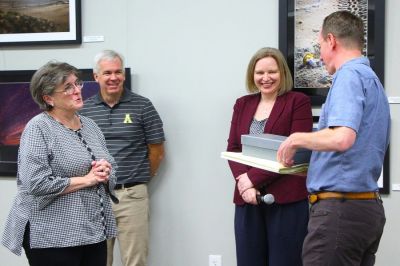
On May 26 last spring, the museum hosted a community supper to officially receive the recordings. Over 100 people from Down East communities were there, including relatives of the people featured in the oral histories. Organizers played excerpts from some of the recordings, and people in the audience heard familiar voices for the first time in decades.
Audrey McGee, one of the students who had participated in the interviews, traveled across the state to attend the event, and she could still remember the lessons she learned about the power of voice.
“You can read words on a page, and that's important, but hearing the voices speak those words is really powerful,” she said.
A NEWSPAPER’S ROLE
The News-Times has been in Phillips family since 1948 and is published twice a week. Tideland News, its sister paper, comes out weekly in the nearby coastal town of Swansboro.
In a 2025 year-end wrapup story, Phillips reported good news for his readers, including statistics showing that the combined web views for the News-Times and the Tideland News recorded over 2.3 million visitors with just over 4 million pageviews.
Both newspapers still come out in print, and in 2019, the News-Times shut down its press and moved its printing to Greenville, North Carolina, located about 80 miles away. In addition to publishing the newspapers, Phillips hosts a radio talk show and a series of podcasts.
Phillips calls his county a power center, making the presence of The News-Times all the more important. “We’re located at the beach, we’re at the point where the railroad ends, and we’re at a state port,” he said. “Three major universities have campuses here.”
Carteret County’s population is about 70,500, according to 2025 U.S. Census estimates.
Phillips’ wife, Nikki, who is the News-Times’ associate publisher, believes that without archives, much of the region’s lived history could disappear.
“Lockwood is the one with all the institutional knowledge,” she said. “And of course, with his mother being from Beaufort, he's steeped in it.”
But if there were no archives, that history would be in danger of vanishing.
Phillips said he recently called a newspaper in another part of North Carolina to ask for a photo to run in the News-Times.
“I ended up having to go through the local museum there because the newspaper didn’t keep archives anymore,” he said. “And this, to me, is a serious concern.”
He advises newspapers to be intentional about preserving their community’s history through archiving.
“That's what it all boils down to, and I think as an industry, there are times we get so busy with the day-to-day activities (that) we don't recognize that what we've doing every day is creating a history,” he said.
Adams, Anspacher and the folks in Down East North Carolina are grateful the News-Times continues maintaining the archives that enabled them to hear once again the voices of long-lost friends, relatives and community leaders and to fill in an essential component to their history.
“People's memories fade, and sometimes they disagree on times, places and events of the past,” Adams said. “But when you look at an old newspaper article or read a page from a phone book, you know that's about as close to the gospel as you can get.”
Teri Saylor is a writer based in Raleigh, North Carolina. Connect with her at terisaylor@hotmail.com.